Menu

Warehouse Flood Restoration in Orlando – Industrial-Grade Recovery That Keeps Your Operations Running

Reliance Water Damage Restoration Orlando deploys commercial-scale warehouse water mitigation and industrial flood recovery systems engineered to minimize downtime, protect inventory, and restore full operational capacity across distribution centers and industrial facilities.

Slider Image 1
Slider Image 2
Slider Image 3
Slider Image 4
Slider Image 5
Slider Image 7
Slider Image 8
Slider Image 9
Slider Image 10
Slider Image 11

Why Orlando Warehouses Face Catastrophic Flood Risk

Orlando's warehouse district sits at the convergence of four high-risk flood factors. Afternoon thunderstorms dump three inches of rain in under an hour during summer months. Flat topography prevents natural drainage. Aging stormwater infrastructure fails during peak demand. Hurricane season brings sustained rainfall that overwhelms roof drainage systems and penetrates loading dock seals.

Your warehouse was built for logistics, not water resistance. Concrete slab foundations absorb groundwater. Metal roofing develops micro-perforations from UV degradation. EPDM membrane seams separate during thermal expansion cycles. Loading dock wells become collection basins during heavy rain events.

The result is predictable. Water infiltrates through the weakest access point, whether that's a failed roof seal, a compromised foundation joint, or a malfunctioning sump system. Within hours, you face inventory contamination, electrical system failure, and structural compromise that halts operations.

Industrial water damage cleanup demands different protocols than residential restoration. You cannot afford multi-day drying timelines. You need commercial flood remediation that accounts for material handling equipment, racking systems, and the thermal mass of concrete floors. You need distribution center water removal scaled to 50,000 square feet, not 2,000.

Orlando's high humidity extends drying windows. Ambient moisture content sits at 75 percent during summer months. Standard air movers cannot overcome the vapor pressure differential. You need industrial dehumidification systems rated for commercial applications, deployed by technicians who understand psychrometric principles and building science.

The cost of delayed warehouse flood restoration is measured in lost revenue, spoiled inventory, and contract penalties. Every hour counts.

Why Orlando Warehouses Face Catastrophic Flood Risk
How Commercial-Scale Water Extraction Actually Works

How Commercial-Scale Water Extraction Actually Works

Warehouse water mitigation starts with containment zone establishment. We map the extent of water intrusion using thermal imaging and moisture meters calibrated for concrete substrates. This identifies the affected square footage and determines equipment deployment density.

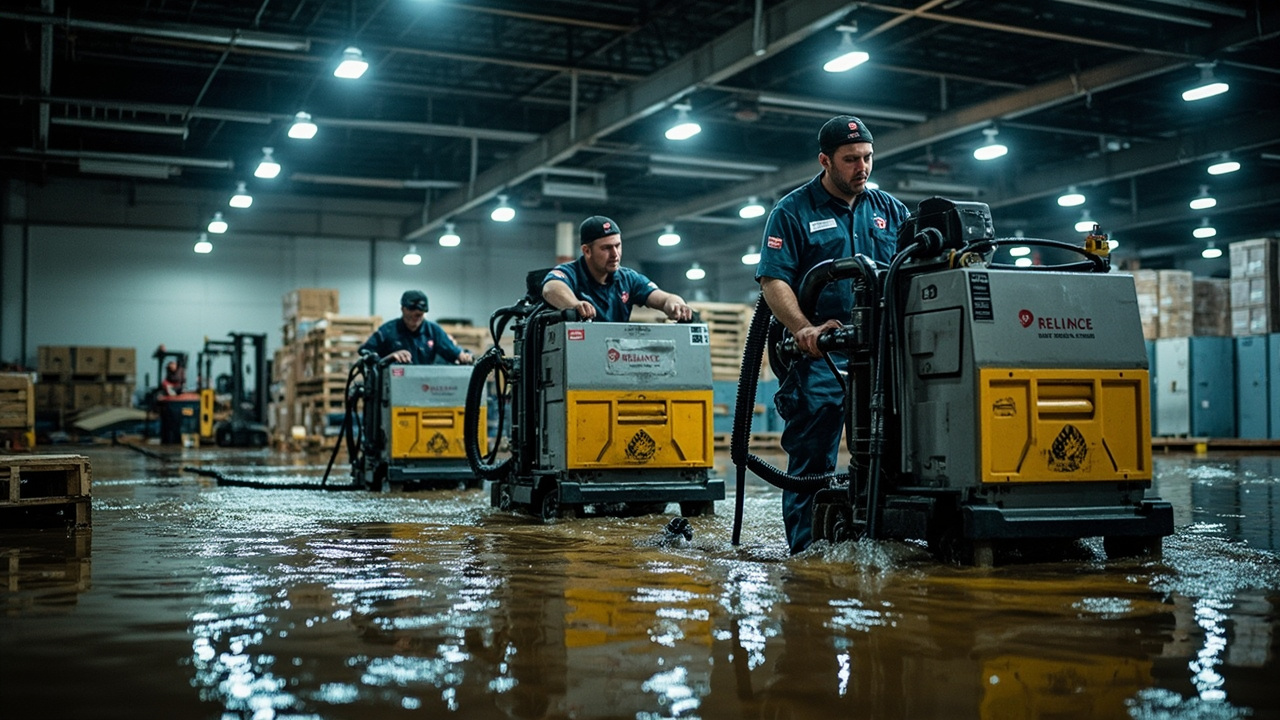
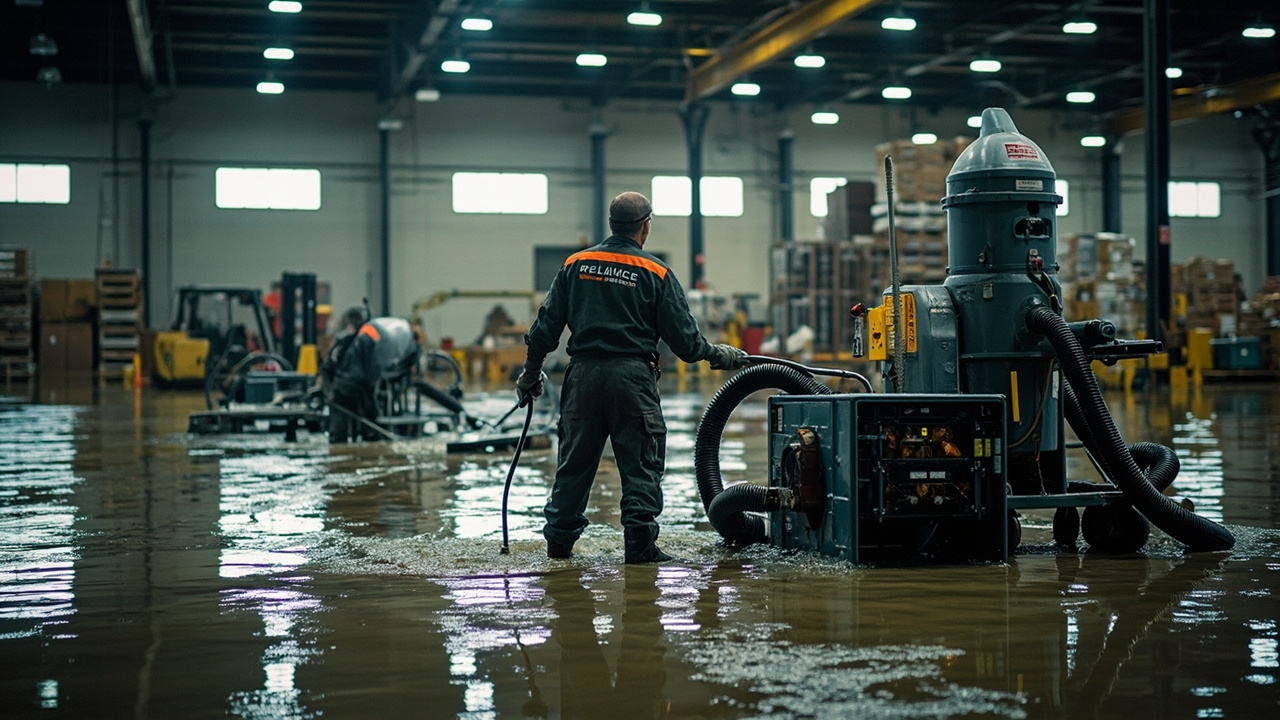
Extraction begins with truck-mounted pumps rated at 200 gallons per minute for standing water removal. Portable extractors handle residual moisture in expansion joints and beneath racking footplates. We do not use residential wet vacs. The scale does not match the problem.

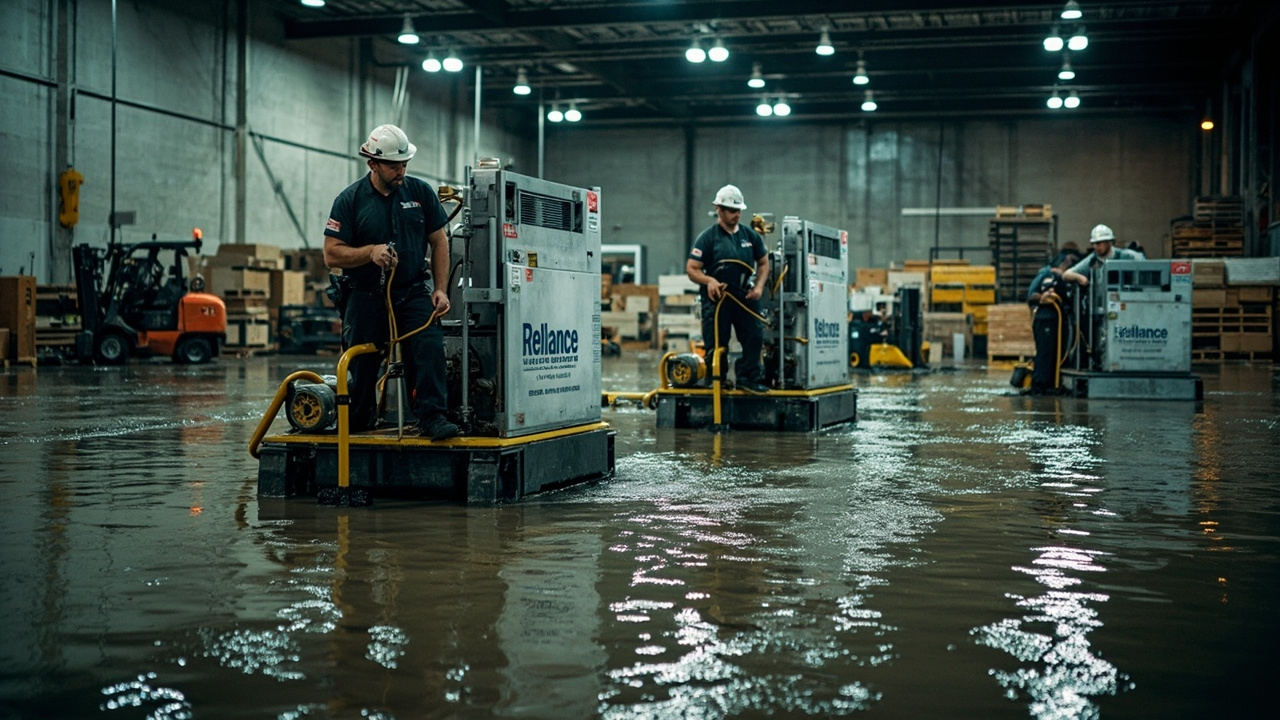
Dehumidification requires calculating grain depression and air changes per hour based on warehouse volume. A 40,000 square foot facility with 24-foot ceilings demands low-grain refrigerant dehumidifiers positioned to create proper airflow patterns. We monitor temperature and relative humidity continuously, adjusting equipment placement as drying progresses.

Concrete slab drying presents the primary challenge. Moisture migrates through capillary action and remains trapped beneath the surface. Surface drying creates a false negative. We use invasive moisture probes to measure slab moisture content at depth, ensuring structural integrity before you resume operations.

Secondary damage prevention requires antimicrobial treatment on porous materials and corrosion inhibitors on metal surfaces. Floodwater introduces bacteria, soil particulates, and organic matter. Without proper remediation, microbial growth begins within 48 hours.

Air quality monitoring verifies safe reoccupancy. We test for elevated particulate counts, volatile organic compounds, and microbial spore concentration. Documentation includes psychrometric logs, moisture mapping reports, and photographic evidence required for insurance claims and liability protection.

The difference between residential and industrial flood recovery is system capacity, technical expertise, and accountability to business continuity requirements. We deploy the equipment and methodology your operation demands.

What Happens During Emergency Warehouse Restoration

Warehouse Flood Restoration in Orlando – Industrial-Grade Recovery That Keeps Your Operations Running
01

Immediate Containment and Assessment

We dispatch within 60 minutes of your call with truck-mounted extraction equipment and thermal imaging cameras. The first priority is stopping water intrusion at the source, whether that means emergency roof tarping, activating sump backup systems, or isolating compromised plumbing. We establish containment zones to prevent cross-contamination into unaffected areas. Initial assessment includes moisture mapping, structural integrity evaluation, and equipment staging based on affected square footage. You receive a preliminary scope within two hours.
02

Industrial Extraction and Drying

High-capacity pumps remove standing water while portable extractors address moisture in confined spaces beneath racking systems and around material handling equipment. We position commercial dehumidifiers to create negative pressure zones that pull moisture from concrete and structural elements. Air movers establish circulation patterns based on warehouse configuration. Drying equipment runs continuously with 24-hour monitoring. We adjust equipment placement as moisture levels decline. Real-time data logging tracks progress and provides documentation for insurance claims and operational records.
03

Verification and Operational Clearance

Final moisture readings must meet IICRC S500 standards for structural drying before we authorize reoccupancy. We conduct air quality testing to verify safe conditions and document completion with psychrometric data, photographic evidence, and equipment logs. Antimicrobial treatment prevents secondary microbial growth. You receive a comprehensive restoration report that includes moisture mapping, drying logs, and certification of completion. Electrical systems undergo inspection before reconnection. We coordinate with your insurance adjuster and provide all documentation required for claim processing and business interruption coverage.

Why Orlando Warehouse Operators Choose Reliance Water Damage Restoration

Commercial flood remediation in Orlando requires understanding local building construction and environmental factors. Most warehouses in the International Drive corridor and Central Florida Research Park were built between 1985 and 2005. These facilities use tilt-up concrete panels, thermoplastic polyolefin roofing membranes, and slab-on-grade foundations. Each construction method presents specific vulnerabilities during flood events.

We know how water migrates through tilt-up panel joints. We understand how TPO membrane seams fail under ponding conditions. We account for the high water table in areas near Lake Conway and the Butler Chain of Lakes. This knowledge determines equipment selection, drying methodology, and timeline projections.

Florida Building Code compliance matters for your liability exposure. Restoration work must meet FBC Chapter 18 requirements for existing buildings. Structural modifications require permits and inspections. We coordinate with Orange County Building Department and ensure all work meets code requirements. Shortcuts create legal exposure.

Our equipment inventory includes truck-mounted extractors, low-grain refrigerant dehumidifiers, and HEPA air scrubbers rated for commercial applications. We maintain redundant equipment to handle simultaneous emergency calls during hurricane season. When multiple facilities flood during tropical storm events, you need a contractor with capacity to respond.

Insurance documentation determines claim approval and reimbursement speed. We provide detailed moisture logs, equipment placement diagrams, and daily progress reports formatted for commercial adjusters. Our documentation has supported successful business interruption claims exceeding six figures. Poor documentation costs you money.

Response time determines total loss exposure. We maintain staging locations near major warehouse districts along State Road 528 and the Beachline Expressway. Average response time is under 90 minutes for facilities in the Orlando metro area. Faster response reduces secondary damage and shortens recovery timelines.

What Your Warehouse Restoration Timeline Actually Looks Like

Emergency Response and Mobilization

We deploy extraction equipment within 60 to 90 minutes of your initial call. Emergency response includes source identification, containment establishment, and preliminary damage assessment. Our crews work 24-hour shifts during active restoration to maintain continuous equipment operation and monitoring. Standing water removal typically completes within four to eight hours depending on volume and facility size. You receive hourly updates during the critical first 24 hours. Equipment staging does not interfere with partial operations in unaffected areas. We coordinate with your operations manager to establish access protocols and maintain security requirements for your facility.

Moisture Assessment and Monitoring Protocol

Initial assessment uses thermal imaging to identify moisture intrusion extent and depth. We establish baseline moisture readings using calibrated meters on concrete floors, wall assemblies, and structural elements. Moisture mapping identifies affected zones and guides equipment placement for maximum efficiency. Daily monitoring tracks drying progress using psychrometric calculations and moisture content measurements. We document ambient temperature, relative humidity, and grain depression to verify drying effectiveness. Invasive probe testing measures concrete moisture content at depth to prevent premature equipment removal. You receive daily reports showing moisture reduction trends and projected completion timelines. Assessment data supports insurance documentation and provides verification of work performed.

Structural Drying and Completion Standards

Concrete slab drying requires three to seven days depending on saturation depth and ambient conditions. We maintain continuous dehumidification and air circulation to achieve optimal drying rates. Final moisture readings must fall below 75 percent relative humidity as measured by in-situ probes before we authorize operational clearance. Air quality testing verifies acceptable particulate levels and absence of elevated microbial counts. All affected areas receive antimicrobial treatment to prevent secondary growth. Final documentation includes completion certification, moisture mapping results, and photographic evidence of pre-loss and post-restoration conditions. Electrical systems undergo inspection and testing before reconnection. You receive comprehensive reports formatted for insurance submission and regulatory compliance requirements.

Post-Restoration Monitoring and Prevention

We provide 30-day post-restoration monitoring to verify moisture stability and confirm absence of secondary issues. Follow-up inspections include moisture readings at previously affected locations and visual assessment for signs of microbial growth or structural concerns. We identify systemic vulnerabilities that contributed to the flood event, including drainage deficiencies, roof membrane condition, and foundation waterproofing failure. Recommendations include preventive measures to reduce future flood risk. Available upgrades include sump system installation, foundation waterproofing, and roof drainage improvements. We coordinate with your facility management team to schedule non-intrusive inspection visits. Documentation provides baseline data for future incidents and supports proactive maintenance planning. Post-restoration support includes priority scheduling for future emergency calls.

Frequently Asked Questions

You Have Questions,
We Have Answers

What's the difference between remediation and restoration? +

Remediation focuses on removing the immediate threat. You extract standing water, remove contaminated materials, and apply antimicrobials to stop mold and bacterial growth. Restoration is the rebuild phase. You repair structural damage, replace drywall, and return your warehouse to operational condition. Most Orlando commercial properties require both services after flooding. You cannot restore a warehouse while Category 3 water remains. You cannot resume operations with bare concrete and exposed studs. The two phases are sequential, not interchangeable. Remediation stabilizes. Restoration rebuilds.

How do restoration companies get paid? +

Most restoration companies work directly with your commercial insurance carrier. They submit an estimate based on industry-standard pricing software like Xactimate. Your carrier reviews and approves the scope. The company completes the work and bills your insurer directly. You pay your deductible. Some Orlando warehouse owners choose out-of-pocket payment to avoid premium increases, especially for smaller incidents under your deductible threshold. Companies may also offer financing for significant uninsured losses. Payment structure depends on your policy terms and the scope of damage.

Who is the alternative to SERVPRO? +

Orlando warehouse owners have multiple alternatives to SERVPRO. Local restoration contractors often provide faster response times because they operate within a smaller service radius. They understand Orlando's specific flood patterns, humidity challenges, and building code requirements. You get direct access to decision-makers instead of franchise management layers. Local firms also maintain relationships with Orlando-area commercial insurance adjusters, which can streamline claims processing. When selecting an alternative, verify the company holds proper licensing, carries commercial liability coverage, and uses IICRC-certified technicians for warehouse flood restoration.

Is water damage restoration worth it? +

For commercial properties, water damage restoration protects your asset value and prevents cascading losses. Untreated warehouse flooding leads to structural deterioration, mold colonization, and inventory loss. Your liability exposure increases if employees or visitors encounter unsafe conditions. Insurance claims become complicated when you delay mitigation. Orlando's humidity accelerates microbial growth, often within 48 hours. Restoration costs seem significant until you compare them against total property loss, business interruption, and potential litigation. The ROI equation favors immediate professional intervention for warehouse flooding.

What are the three types of remediation? +

Water damage remediation uses three contamination categories. Category 1 involves clean water from supply lines or rainwater. Category 2 is gray water containing biological or chemical contaminants, like discharge from washing machines or sump pumps. Category 3 is black water with pathogenic bacteria and toxins, sourced from sewage backups or floodwater. Orlando warehouses frequently face Category 3 events during hurricane season. Each category requires different safety protocols, disposal procedures, and antimicrobial treatments. Misidentifying the category creates liability exposure and incomplete remediation.

What are the 3 R's of recovery? +

The three Rs of disaster recovery are response, remediation, and restoration. Response addresses immediate safety threats and stops ongoing damage. You shut off water sources, establish containment zones, and extract standing water. Remediation removes contaminated materials and treats affected surfaces to prevent secondary damage. Restoration rebuilds your warehouse to pre-loss condition. Orlando commercial properties must complete all three phases to resume operations safely. Skipping phases or compressing timelines creates compliance issues and leaves your facility vulnerable to mold growth or structural failure.

Do you need a license for restoration? +

Florida requires restoration contractors to hold appropriate licensing for the work performed. General contractors need a state-issued license for structural repairs. Mold remediation requires a separate state license and certification. Water extraction and drying may fall under different classifications depending on the scope. Orlando warehouse projects often trigger commercial building permit requirements. Your restoration company should carry workers' compensation insurance and commercial general liability coverage. Always verify licensing status through the Florida Department of Business and Professional Regulation before authorizing warehouse flood restoration work.

What not to say to claim adjuster? +

Never admit fault or speculate about causes when speaking with your claims adjuster. Do not minimize damage to appear cooperative. Avoid phrases like it is not that bad or we can handle this ourselves. Do not accept the first settlement offer without professional review. Never sign a proof of loss form before your restoration contractor completes a detailed assessment. For Orlando warehouse floods, do not discuss deferred maintenance or prior water issues unless directly asked with documentation. Provide factual information about the incident timeline and immediate actions taken. Let documentation speak.

Do restoration companies make good money? +

Restoration company profitability varies based on market density, operational efficiency, and insurance carrier relationships. High-volume operators processing numerous small claims face different margins than companies handling complex commercial projects. Orlando's hurricane exposure creates seasonal demand spikes, affecting revenue predictability. Successful restoration businesses invest heavily in equipment, training, and rapid response capabilities. Labor costs, vehicle maintenance, and insurance premiums reduce gross margins significantly. The question matters less to warehouse owners than contractor reliability, technical competency, and ability to minimize your business interruption during flood restoration.

What is the lawsuit against SERVPRO? +

Multiple lawsuits have targeted SERVPRO over the years, ranging from employment disputes to franchise agreement conflicts. Some involved allegations of improper mold remediation practices or billing disputes with insurance carriers. Specific case details vary by jurisdiction and remain subject to legal confidentiality agreements. Orlando warehouse owners should focus less on litigation history and more on the specific franchise location's performance record, technician certifications, and references from similar commercial projects. Any restoration company faces potential litigation in a litigious industry. Verify current licensing status, insurance coverage, and local reputation before engaging any contractor.

How Orlando's Water Table and Storm Patterns Impact Warehouse Flooding

Orlando sits at 82 feet above sea level with a water table ranging from three to 15 feet below grade depending on proximity to lakes and wetlands. Warehouses built near Lake Nona, Doctor Phillips, and the Conway area face elevated groundwater intrusion risk during wet season. Summer rainfall averages seven inches per month from June through September. Afternoon thunderstorms deposit localized flooding in low-lying areas faster than stormwater systems can evacuate runoff. Hurricane season compounds the problem with sustained rainfall events that saturate soil and overwhelm foundation drainage systems. Industrial flood recovery in Orlando requires understanding how seasonal water table fluctuations affect concrete slab moisture migration and subsurface hydrostatic pressure on foundation walls.

Commercial water damage restoration in Orange County requires coordination with local building officials and adherence to Florida-specific construction standards. The South Florida Building Code governs restoration work on commercial structures. Warehouse facilities built before 2002 may lack current flood mitigation requirements including proper foundation waterproofing and adequate roof drainage capacity. Local expertise matters when navigating permit requirements for structural repairs and coordinating inspections with Orange County Building Department. Reliance Water Damage Restoration Orlando maintains relationships with local adjusters, engineers, and code officials to expedite approvals and ensure compliance. Choosing a contractor familiar with Orlando's regulatory environment and environmental challenges reduces delays and prevents code violations that halt operations.
Water Damage Restoration Services in The Orlanado Area

Looking for fast and reliable water damage restoration in your area? Reliance Water Damage Restoration Orlando proudly serves homes and businesses throughout Orlando and surrounding communities. Whether you're dealing with flood damage, burst pipes, or mold issues, our expert team is ready to respond 24/7. We use industry-leading equipment to extract water, dry structures, and restore your property to pre-loss condition. Check the map below to see if we service your neighborhood, or call now for immediate help.

Address:
Reliance Water Damage Restoration Orlando, 7380 W Sand Lake Rd Suite 500, Orlando, FL, 32819

Additional Services We Offer

Our news updates

Latest Articles & News from The Blogs

Lorem ipsum dolor sit amet. Aut expedita quaerat quo eligendi numquam et laudantium perspiciatis qui minima expedita rem consequatur ducimus.…

Test Blog 4

Lorem ipsum dolor sit amet. Aut expedita quaerat quo eligendi numquam et laudantium perspiciatis qui minima expedita rem consequatur ducimus.…

Test Blog 3

Lorem ipsum dolor sit amet. Aut expedita quaerat quo eligendi numquam et laudantium perspiciatis qui minima expedita rem consequatur ducimus.…

Test Blog 2

Lorem ipsum dolor sit amet. Aut expedita quaerat quo eligendi numquam et laudantium perspiciatis qui minima expedita rem consequatur ducimus.…

Contact Us

Every hour of delayed response increases your total loss exposure. Call Reliance Water Damage Restoration Orlando now at (689) 268-2233 for immediate dispatch of commercial-grade extraction and drying equipment. We answer 24 hours a day, 365 days a year.